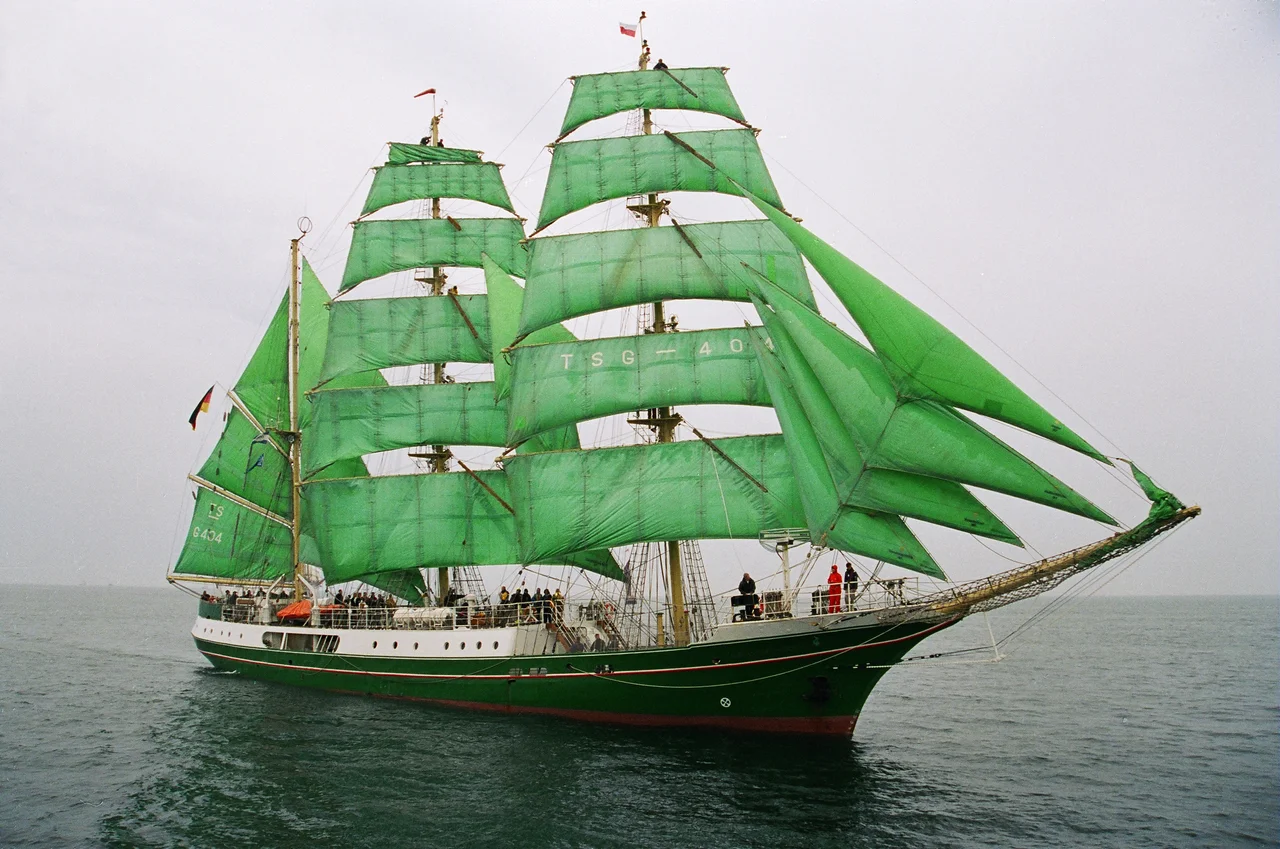

Alexander von Humboldt
For eighty years the ship never went anywhere on purpose. She was launched at Bremen in 1906 as a spare part: a reserve lightvessel, kept ready to take over the station of any floating lighthouse that had to go into the yard for maintenance. Her working life consisted of being towed to a set of coordinates, anchored, and left to shine. She had the hull of a sailing ship, which was normal for the type, but where the mainmast should have stood there was a lamp instead. Then in 1988, at the age of eighty-two, she was fitted with three masts and a suit of sails dyed dark green, handed to a foundation that taught teenagers to sail, and sent out to do the thing her shape had always implied. She would go on to log more than 300,000 nautical miles and round Cape Horn in her centenary year.
The Ship That Stood Still
She went down the ways at AG Weser in Bremen on 10 September 1906 as yard number 155, the first of her class. Even her name is uncertain. Two are documented - Reserve Fehmarnbelt, after the station she first covered, and Reserve Sonderburg, after a home port at Sonderburg in what is now Danish Soenderborg - and the ship's bell settles nothing, since it reads only Reserve. From 1920 to 1945 she was based at Kiel-Holtenau and worked stations up and down the Baltic. In 1945 she was made the permanent stand-in for the lightvessel Kiel, which had been bombed. In the spring of 1957 a Swedish freighter rammed and sank her; she was raised, spent two years in refit, and went back on station in 1959. When her position was upgraded to a proper lighthouse in 1967 she returned to the reserve, then took over permanently from the retired Amrumbank until an automated light vessel displaced her too. After one more collision and an overhaul at Wilhelmshaven she was towed to Bremerhaven and renamed Confidentia - a laid-up hull with a Latin name and no obvious future.
Green Sails
The German Sail Training Foundation, newly established, bought her and handed the drawings to Zygmunt Choren, the Polish naval architect responsible for a good share of the world's modern tall ships. He turned the lightvessel into a three-masted barque: 62.55 metres overall, 8.02 across the beam, 1,035 square metres of canvas, twenty-three permanent crew and berths for up to thirty-six trainees. She was christened Alexander von Humboldt on 30 May 1988. The hull was painted green as a nod to the sailing ships of the Rickmers line of Bremerhaven. The sails were green for a blunter reason: Beck's, the Bremen brewery, was a founding member of the foundation and wanted them in its advertising, which it got, thoroughly and for decades. It was one of the more honest sponsorship deals in sailing, and it made her the single most recognisable ship in northern European waters. Nobody who saw those sails on the horizon ever had to ask which vessel it was.
Fourteen Times Around the Equator
Alex, as her crews called her, spent twenty years as the foundation's flagship and covered more than 300,000 nautical miles - the equivalent of fourteen laps of the equator. Summers meant the North Sea and the Baltic, autumn and winter the run down to the Canaries, and each year the tall ships' races, which she entered as a working sail-training vessel rather than a museum piece. Her longest passage retraced the voyage of the man she was named after, following Alexander von Humboldt's expedition route to South America and the Caribbean. In January 2006, a hundred years after her launch, she rounded Cape Horn under sail. The mileage was never really the point. The model of sail training rests on the idea that a sixteen-year-old sent out on a yard at night, in weather, in a watch that depends on them, comes back down as a different person - and for two decades, several thousand of them found out whether that was true aboard a converted lightship.
Masts Down at the Schlachte
In October 2011 a purpose-built successor, Alexander von Humboldt II, took over the training work, and the old ship was sold. She went to the Bahamas in early 2012 for a Caribbean charter business that never materialised, and came back to Europe in early 2013. Her hull was repaired and repainted; her bow thruster and main propeller were removed permanently, which settled the question of whether she would ever move under her own power again. In 2014 she became a hotel and restaurant with forty-two bunks in sixteen cabins - a botel, in the trade's inelegant word. She lay at the Europahafen in Bremen from 19 April 2015, and on 24 October 2016 she was shifted to the Schlachte, the old riverside quay in the middle of the city, where she remains. To get there she had to pass beneath three bridges, so her masts and rigging were taken off her first. A ship that had carried teenagers around Cape Horn under sail was dismasted to travel the last two kilometres, back to within sight of the yard that built her.
From the Air
The ship lies at 53.0748N, 8.8032E, moored at the Schlachte on the right bank of the Weser in central Bremen, immediately west of the old town. From the air she is a distinct dark hull against the stone quay on the outside of the river's bend, a few hundred metres downstream of the Buergermeister-Smidt-Bruecke and directly across the water from the Neustadt bank - though with her masts removed she no longer casts the giveaway rigging shadow she once did. The Weser through Bremen is the obvious line feature, curving north-west toward Bremerhaven and the North Sea some 60 km away; the twin towers of Bremen Cathedral and the market square sit just inland of the mooring. Bremen Airport (EDDW) is about 4 km south-south-west of the city centre, and its controlled airspace covers the whole of central Bremen, so any low-level look at the waterfront needs coordination first. A viewing altitude of 1,500 to 2,500 feet AGL frames the Schlachte, the old town and the river bend together. The Weser valley here is flat and near sea level, and low cloud and drizzle off the North Sea are the normal condition rather than the exception.
Nearby Stories
- Teufelsmoor 4.9 km away
- Hatten 6.3 km away
- Vechta 10 km away
- Hurricane Festival 18 km away
- Stadland 19 km away
- Herrenhausen Gardens 41 km away
- Schöma 42 km away
- Neuengamme concentration camp 52 km away