.jpg)
Capitulation of Stettin
Antoine Lasalle rode up to the fortress of Stettin on the afternoon of 29 October 1806 with eight hundred hussars and two field guns. Behind its walls stood 5,300 Prussian soldiers, 281 cannon, and provisions enough to sit out a long siege. By the small hours of the next morning the place was his. Napoleon's note of congratulation to Marshal Murat was only half a joke: "My compliments on the capture of Stettin; if your light cavalry thus takes fortified towns, I must disband the engineers and melt down my heavy artillery." The city is Szczecin now, a Polish port where the Oder braids toward the Baltic, and the surrender that happened here is still taught as a case study in what fear does to an army.
Fifteen Days After Jena
Napoleon's Grande Armée had shattered the Prussian and Saxon armies at Jena-Auerstedt on 14 October. The Duke of Brunswick, who commanded at Auerstedt, took a mortal wound and died at Ottensen, near Hamburg, on 10 November; Ernst von Rüchel was carried off the field at Jena. What survived crossed the Elbe and ran northeast for the Oder with Murat's cavalry at its heels. The chase lasted a fortnight. At Prenzlau on 28 October, Murat cornered Hohenlohe and bluffed more than 10,000 men into laying down their arms by insisting they were already surrounded. The next morning at Pasewalk, Oberst von Hagen found Lasalle in front of him and Milhaud behind, and surrendered 4,200 soldiers and eight guns. Marshal Lannes summarized the campaign for Napoleon in a sentence: "The Prussian army is in such a state of panic that the mere appearance of a Frenchman is enough to make it lay down its arms."
The Second Summons
Lasalle demanded Stettin's surrender in the early afternoon of the 29th, and Lieutenant General Friedrich Gisbert Wilhelm von Romberg refused him. At four o'clock a second summons arrived, this one carrying a threat of harsh treatment for the city and the claim that Lannes' entire V Corps — thirty thousand men — stood outside the gates. It did not. The corps' advance guard got no nearer than Löcknitz that day, and everything beyond Lasalle's eight hundred horsemen was invention. The elderly Prussian general, by every account thoroughly unnerved and convinced he faced an army, opened negotiations and signed during the night of 29/30 October.
What Changed Hands
Romberg handed over the fortress, 5,300 troops and 281 guns. The garrison was a patchwork: survivors of Schimmelpfennig's flank guard, cut up at Zehdenick three days earlier, together with the third battalions of seven infantry regiments. One hundred officers were released on their word of honor not to fight France again. The common soldiers went into captivity as prisoners of war — an asymmetry the men on the walls had no vote in. Neither of Romberg's senior subordinates objected to any of it: not General-Major Kurt Gottfried von Knobelsdorff, the fortress commandant, nor General-Major Bonaventura von Rauch, who commanded Fort Prussia. Lasalle's whole force was the 5th and 7th Hussar Regiments and two cannons.
The Reckoning
Prussia did not let it go. In March 1809, Romberg was convicted of giving up Stettin without a fight and sentenced to life imprisonment; he died on 21 May that year, two months short of his eightieth birthday, before the sentence began. The pattern repeated up and down the Oder. Küstrin fell on 1 November to a single brigade of Davout's III Corps, though Oberst von Ingersleben held 92 guns and full magazines; he was sentenced to death for cowardice, and King Frederick William III commuted it to life. The historian Francis Loraine Petre called Stettin's surrender "shameful," pointing out that the garrison had the supplies to withstand a siege and, failing that, could simply have crossed to the east bank of the Oder, joined the Russian allies, and kept fighting. What went missing that autumn was not courage in any individual sense. It was the belief that resistance would accomplish anything.
A Siege That Never Happened
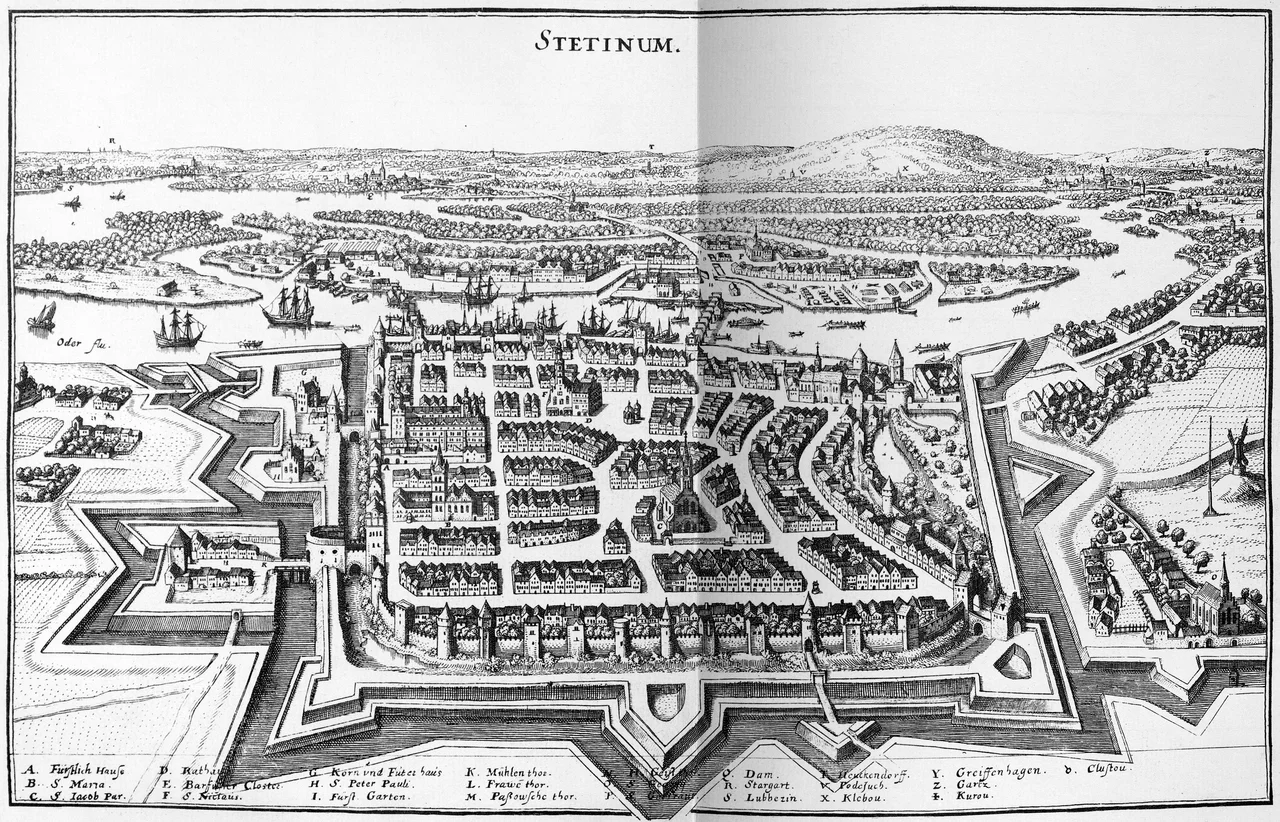
Antoine-Jean Gros painted General Lasalle at the Siege of Stettin and exhibited it at the Salon of 1808 in the Louvre — a heroic canvas commemorating an assault nobody made. Within a week of the capitulation, three isolated Prussian columns were hunted down at Boldekow, Anklam and Wolgast, leaving only Blücher's force still at large between the Elbe and the Oder; Soult, Bernadotte and Murat ran him down at Lübeck on 6 November. Stettin's ramparts are largely gone today, buried under a working Baltic port about 120 km northeast of Berlin. What survives of 29 October 1806 is the arithmetic — eight hundred against fifty-three hundred — which is the only reason a footnote in a catastrophic autumn is remembered at all.
From the Air
Szczecin sits at 53.43°N, 14.55°E, on the Oder about 65 km upstream of the Baltic and roughly 120 km northeast of Berlin. Best viewed at 2,500-5,000 ft AGL. Navigationally the area is generous: the Oder splits into a braided delta below the old town, the broad Dąbie Lake lies immediately east, and the Szczecin Lagoon opens to the north — the water network that made the fortress worth holding. The port cranes and the Gothic bulk of St. James' Cathedral mark the historic core where Romberg's walls once stood. Nearest airports: Szczecin-Goleniów Solidarność (EPSC) about 30 km northeast, the general-aviation field at Szczecin-Dąbie (EPSD) on the city's eastern edge, and Berlin Brandenburg (EDDB) about 140 km southwest. Expect Baltic haze and low stratus in autumn and winter.
Nearby Stories
- Kingdom of Prussia 10 km away
- Battle of Prenzlau 14 km away
- St. Mary's Church, Chojna 17 km away
- Gorzów Wielkopolski 40 km away
- Historical Technical Museum, Peenemünde 61 km away
- Stalag Luft III 195 km away
- Lilleø 248 km away
- Stutthof Concentration Camp 276 km away