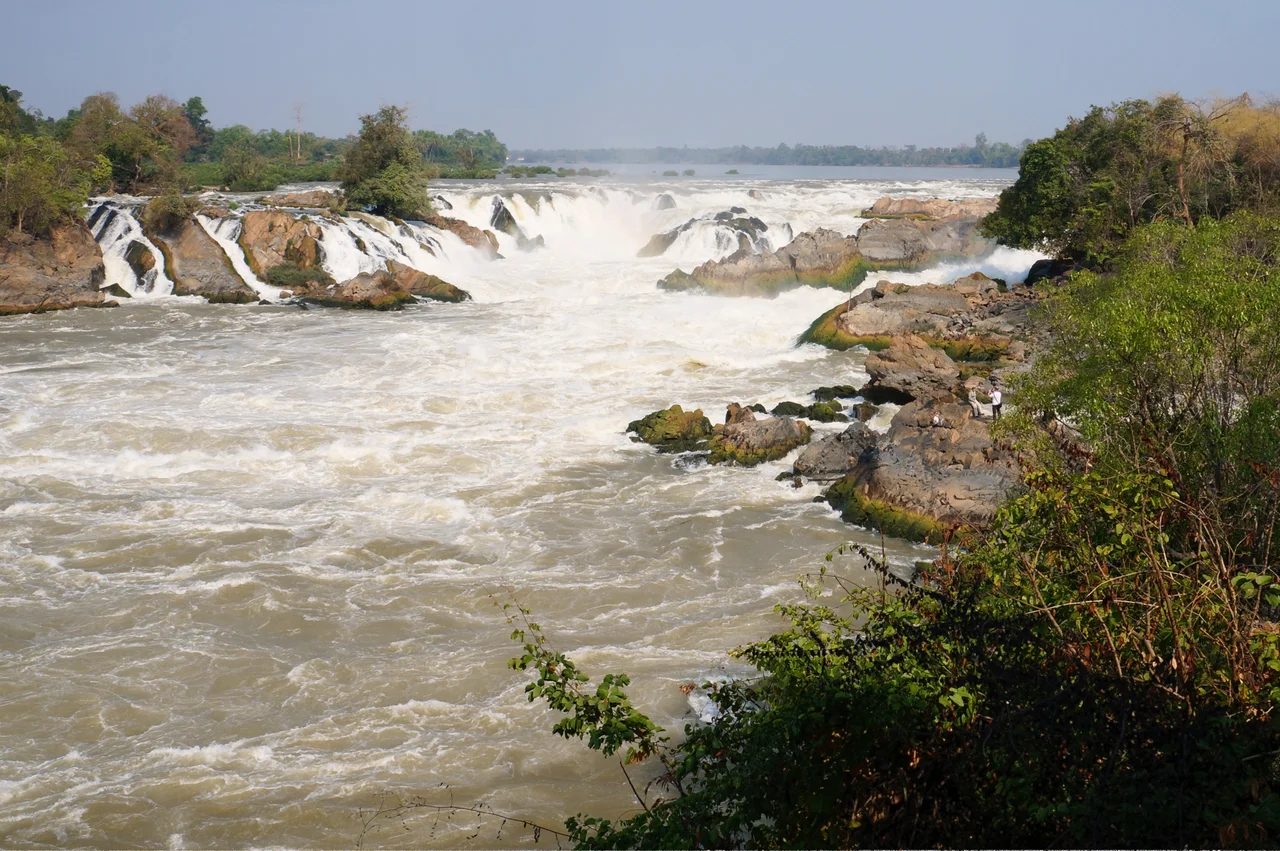

Khone Phapheng Falls
By one measure this is the biggest waterfall on the planet, and almost nobody outside Laos can name it. Khone Phapheng is not tall. Its highest single drop is 21 metres, about the height of a six-storey building, and it makes no postcard of a white ribbon plunging off a cliff. What it has is width. Measured from the outermost edge of one channel to the outermost edge of another, across every chute and ledge and rock-choked spillway the river uses, the falls run 10,783 metres — 6.7 miles. You cannot photograph that. You can only stand at one end of it and listen.
Eleven Thousand Tonnes a Second
Numbers do more work here than adjectives. The average discharge over the cataract is close to 11,000 cubic metres per second — eleven thousand tonnes of water leaving the ledge every second of an average day. The highest flow ever recorded exceeded 49,000. The whitewater is not confined to a single lip either; the succession of rapids stretches 9.7 kilometres along the river's length, so the Mekong spends nearly ten kilometres falling apart. Season changes everything. In the dry months from November to March the water pulls back to expose black basalt shelves and pools, and individual falls resolve into separate, comprehensible things. From June the monsoon fills every channel simultaneously, the shelves vanish, and the whole width of the river turns into one continuous, roaring sheet of brown.
The Falls Made the Islands
Everything upstream is a consequence of this ledge. Water hitting a resistant rock threshold splits, slows, drops its sediment, and finds new ways around — and after enough millennia of that, the river above the falls is no longer a river but a maze. The result is the archipelago known as Si Phan Don, the Four Thousand Islands: thousands of channels and hundreds of islands filling the valley floor of Champasak Province right up to the Cambodian border. The name of the region is, in effect, a description of the waterfall's debris field. Half of those islands submerge again each flood season, which means the landscape the falls built is one the falls keep rebuilding.
The River That Refused to Be a Road
France wanted this river badly. In the late nineteenth century the colonial administration of Indochina saw the Mekong as the artery that would bind Cochin-China, Cambodia, Laos and Tonkin into one system, and further upstream lay the real ambition — a trade route into southern China, and leverage against British expansion in Upper Burma. Everything depended on getting steamers past this point. They tried in 1891, in 1892 and in 1893. Contemporary accounts describe engines roaring and boilers near bursting while hundreds of men hauled on ropes from the rocks and others shoved from the decks with pikes. One vessel is said to have wriggled its way up a narrow water-slide to within fifty metres of the top before the attempt was abandoned. The men on the ropes were not the ones who had chosen the ambition. They were labourers of French Indochina, doing lethal work on wet rock so that a gunboat might reach Yunnan.
What Failure Left Behind
The empire gave up on the water and went overland instead. Rather than fight the falls, the French built a seven-kilometre narrow-gauge portage railway across the islands of Don Khon and Don Det, on which specially designed boats could be dismantled, carried past the obstruction, reassembled and relaunched upstream. It opened in 1893 and its last train ran in 1940. That railway remains the strangest monument any waterfall has produced: a set of tracks that existed purely as an apology for a river. And the falls won the larger argument permanently. The Mekong has never become navigable into China, and the modern freight that once justified the whole scheme now moves on highways and through airports.
Giants in the White Water
The cataract is also a wall for anything that swims. Migratory fish moving up the Mekong have to find a way through the complex, and only a limited set of channels ever offered one — a fact that has made this stretch of river one of the most contested pieces of water in Southeast Asia, since a single blocked channel can affect fisheries hundreds of kilometres away. Among the species here is the plabuck, the Mekong giant catfish, an endangered animal reported to reach three metres and 646 pounds and often called the largest freshwater fish in the world. Something far smaller is arguably rarer: Hemimyzon khonensis, a hillstream loach, is known to science from a single specimen collected in the Mekong at these falls and has never been reliably found again.
Standing at the Edge
Getting here is straightforward in a way the nineteenth century would have envied. The viewing area sits on the mainland east of the islands, off Route 13, and tuk-tuks run out from the boat village of Ban Nakasang for a modest fee. Walkways and platforms bring you close enough that the spray reaches you and conversation stops working. Go in the wet season for raw volume and a horizon of moving water; go in the dry season to actually see the architecture of the thing — the ledges, the sluices, the polished rock, the fishermen working the margins on bamboo platforms where the current is survivable. Either way, the reason southern Laos ends here in a scatter of islands rather than continuing as a shipping lane is directly in front of you, making a great deal of noise about it.
From the Air
Khone Phapheng Falls lie at 13.9597°N, 105.9867°E (13°56′53″N 105°56′26″E) in Champasak Province, southern Laos, roughly 5 km north of the Cambodian border. From 3,000-8,000 ft the cataract is one of the clearest natural waypoints in the lower Mekong basin: a broad east-west band of white water and exposed dark rock nearly 11 km wide, with braided channels feeding in from the Si Phan Don archipelago to the northwest and the river re-forming into a single dark channel to the south. Route 13 passes just east of the viewpoint. Nearest airport is Pakse International (VLPS/PKZ, elevation 351 ft) about 135 km north; Ubon Ratchathani (VTUU) in Thailand is the nearest major field, and Stung Treng (VDST) across the border has been closed to fixed-wing traffic since 2003. Visibility is best November through March; monsoon months bring haze and strong afternoon convection, though the falls themselves are at their most spectacular then.
Nearby Stories
- Sekong Bridge 19 km away
- Veun Sai-Siem Pang National Park 23 km away
- Emerald Triangle (Southeast Asia) 30 km away
- Stung Sen Dam 51 km away
- Virachey National Park 52 km away
- Preah Vihear province 58 km away
- Vat Phou 71 km away
- Chu Pong Massif 124 km away