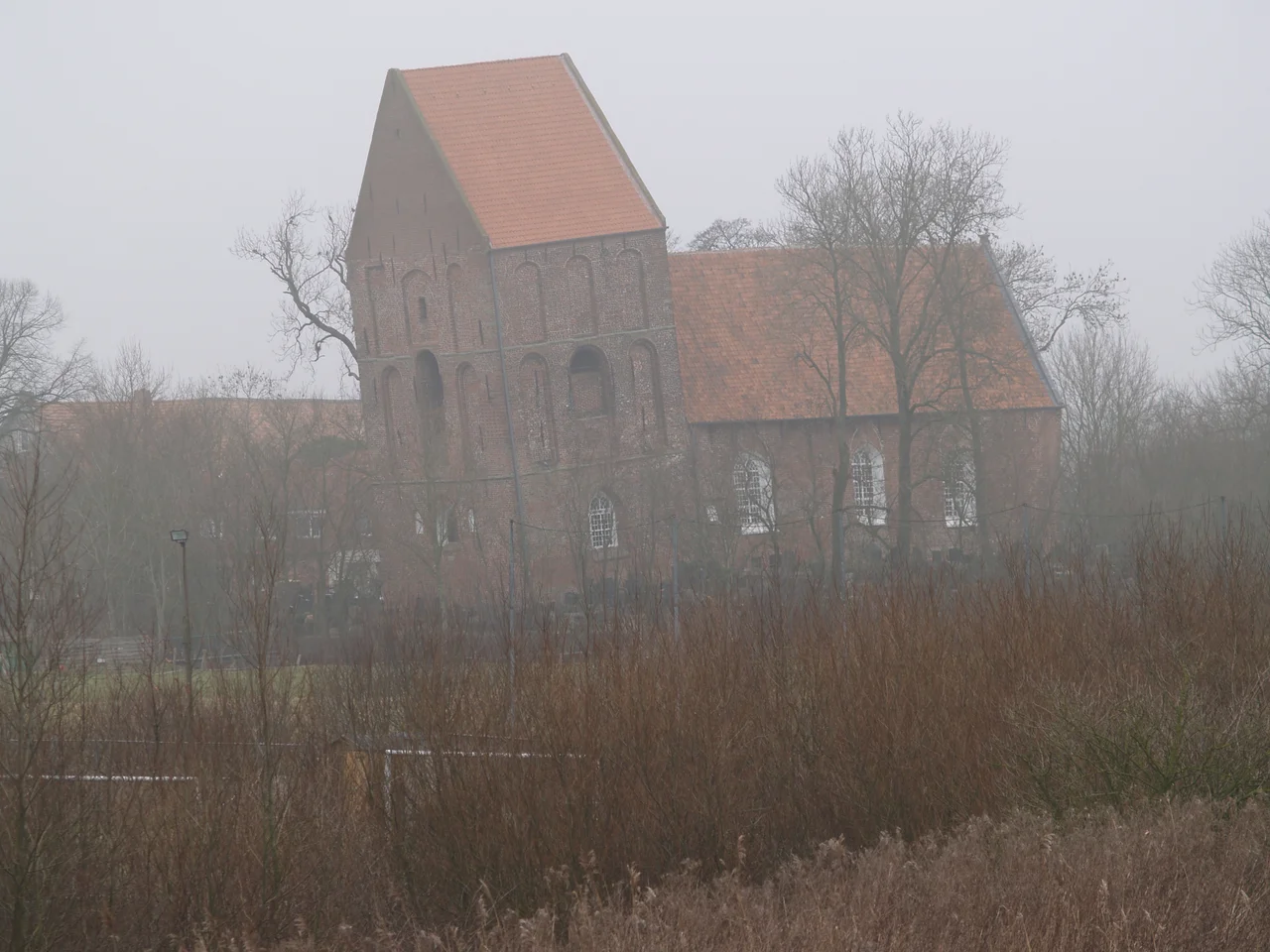

Leaning Tower of Suurhusen
For roughly four centuries the church tower at Suurhusen stood more or less where its builders put it. What eventually tipped it over was not an earthquake, not a siege, not shoddy bricklaying. It was drainage. This is East Frisia, flat country a few kilometres inland from the Ems estuary, and in the nineteenth century farmers here did what farmers all across the North German marshes were doing: they pulled the water out of the ground to make the land pay. The medieval church had been built on a raft of oak trunks driven into the marsh, and those trunks had survived five hundred years precisely because they were permanently soaked. Exposed to air, they rotted. The tower started to go over, and it has been going ever since.
Squeezed Into the Nave
The church is Brick Gothic - the red-brick architecture of the North German and Baltic coasts - and it has the squat, thick-walled look of the old fortress churches that doubled as refuges when the sea or a neighbour came calling. It began as a long hall, roughly 32 metres by 9.35 metres.
Then, in 1450, the congregation did something that would matter enormously five hundred years later. They shortened the building by about a quarter and built a tower into the space they had cleared. That tower stands 27.37 metres tall and weighs something in the order of 2,116 tonnes. Its foundation is two metres of masonry resting on those oak piles. Two metres of stone and a stand of felled trees, holding up a great deal of brick, on ground that is essentially wet sponge. It worked beautifully as long as nobody touched the water table.
One Point Two Two Degrees
The numbers are what brought the world to a village most Germans could not find on a map. The steeple leans at 5.19 degrees - 5 degrees and 11 minutes - which puts its top 2.47 metres out from where it should be. The Leaning Tower of Pisa, after the stabilisation work that saved it, leans 3.97 degrees. Suurhusen therefore out-tilts the most famous leaning building on Earth by 1.22 degrees, and in 2007 Guinness World Records said so in print.
It did not keep the outright title. In 2010 the Capital Gate tower in Abu Dhabi claimed the record for the most tilted tower, but Capital Gate leans on purpose - it was engineered that way, as was Montreal's inclined Olympic tower. Suurhusen's distinction is narrower and arguably better: it is the most tilted tower in the world that nobody meant to tilt. A village parish church holds a world record entirely by accident.
Ten Years Shut
By the 1970s the lean had stopped being charming. In 1975 the steeple was closed to the public on safety grounds and stayed shut for a decade while engineers worked out how to arrest it without straightening it - the same delicate problem Pisa would confront two decades later. It reopened in 1985: stabilised, still crooked, still the thing everyone came to see.
Nobody has tried to correct it. Correcting it would destroy the only feature of the building that anyone outside East Frisia has ever heard of, and would very likely be more dangerous than leaving it alone. The lean is now the entire point of the structure, in a way its fifteenth-century builders would have found completely baffling.
A Working Church, Still
For all the record-breaking, this is not a monument. It is a Reformed parish church in a quiet corner of Lower Saxony, still in use, with services, a congregation and a graveyard around it. Visitors climb the stairs inside, which is a genuinely disorienting experience - the walls and your inner ear disagree about which way is down - and then step back out into fields kept dry by the same ditches that undid the foundations.
That is the local irony worth standing in. The tower is famous because East Frisians were unusually good at draining land. The engineering that made this whole landscape farmable is the engineering that undermined its oldest building. Every leaning tower is a story about ground. This one is a story about what people did to the ground.
From the Air
The Leaning Tower of Suurhusen stands at 53.41 degrees N, 7.22 degrees E, in the flat marshland of East Frisia about 8 km east of Emden and a few kilometres inland from the Ems estuary. The surrounding country is intensively drained polder - a grid of straight ditches and canals visible from altitude, with the Ems and the Dollart bay to the west. The tower itself is small and only picks up at low level; use the village cluster and the church roofline. Nearest airport is Emden (EDWE), roughly 10 km west; Leer-Papenburg (EDWF) lies about 25 km southeast, and Groningen Eelde (EHGG) about 55 km west across the Dutch border. Best viewing altitude 1,500-2,500 feet. Coastal fog and low stratus are common here in spring and autumn.
Nearby Stories
- Tynaarlo 5.3 km away
- Organ in the Jacobikerk at Uithuizen 6.4 km away
- Bourtange 8.9 km away
- Norderney Airport 11 km away
- Razing of Friesoythe 11 km away
- Harle (gat) 19 km away
- Lordship of Gödens 22 km away
- Alpha Ventus Offshore Wind Farm 45 km away